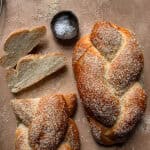
Vegan Challah
Fluffy, tender and delicious traditional challah eggs free.
Servings 2 loafs
Ingredients
- 7.5 Cups Unbleached all-purpose flour (900g)
- 1 Tablespoon Instant yeast (12g)
- 2 teaspoons Salt (14g)
- 1/4 Cup Sugar (50g)
- 2 Cups Lukewarm water (480ml)
- 1/4 Cup Oil (60ml)
- 1/4 Cup Plant base milk (60ml)
- 2 teaspoons Maple syrup
- pinch Baking soda
- 1/4 Cup Sesame seeds, poppy seeds for topping (optional)
Instructions
- Sift the flour in a large bowl, or a bowl of a stand mixer and add the yeast, sugar, and salt.
- Use a fork or the paddle attachment to mix the ingredients for about 30 seconds.
- Drizzle in one cup of the water while mixing the dry ingredients using a wooden spoon. Or on low speed.
- Drizzle in the oil, followed by the rest of the ingredients.
- Keep mixing until the flour is completely hydrated and you have a shaggy mass.
- Use your hands (or the dough hook) to knead the dough until it is smooth and stretchy. The dough might be slightly sticky, that's ok do not add more flour, the starches will absorb the water during the rest time.
- Spray the dough with oil, place in a large bowl, cover with plastic wrap and set aside to rest for 90 minutes.
Shape the dough
- Remove the plastic wrap and gently punch the dough with your fist.
- Divide the dough into two equal parts (each approx 730g).
- Divide each piece to 3,4,5, or 6 equal pieces, depending on braids you wish to use for braiding the challah.
- Roll each piece to 16-imch log, and braid the dough.
- Gently lift the braided bread, and place it over a large baking sheet lined with parchment paper.
- Brush with the egg wash subsitute (or an egg), sprinkle with your choice of topping and set aside to rest for 60 minutes.
- Bake in a 350F (180C) preheated oven for 25-30 minutes, until the challah is medium golden brown.
Notes
- To use active dry yeast: mix 4 1/2 teaspoons of active dry yeast with 2 teaspoons of the sugar and 1 cup of the water and mix. Allow it to sit for 10-15 minutes until the top is frothy. Add the mixed dry ingredients and continue with the recipe.
- You can use a combination of bread flour, or replace 1/2 cup (60g) of the flour with whole wheat flour.
- Store at room temperature for up to 3 days in aplastic bag.
- Wrap with plastic wrap or aluminum foil place in a plastic bag and freeze for up to two months. When ready unwrap and place at room temperature. For extra crispiness, bake at 250-300F for 25-20 minutes.
- For the best challah results, use a kitchen scale to measure your ingredients. If using a measuring cup, aerate the flour with a fork before spooning it into the cup, and use the same cup to measure the liquids.
- Be careful not to under-knead or over-knead the dough. To check if the dough is ready, cut a small piece and gently stretch it between your fingers; if it stretches easily, it’s ready.
- The dough might seem too sticky initially, but that’s okay. The starches in the dough will absorb the water during the resting period.